Germany, our main route
Germany is our most frequent destination. With our branch in Germany, our teams survey, pack and load directly at your home in any German city. In Istanbul our customs team handles the import, and we deliver anywhere in Turkey.
Both directions
We also move families from Turkey to Germany – for work, family reunion or study – including customs. People transferring their residence to the EU can, under certain conditions, import used household goods duty-free.
Moving from Turkey to Germany
Every year thousands of families move from Turkey to Germany – for a new job, to join family members or to study. Alongside visas and flat hunting, the question arises of how furniture, kitchen equipment and personal belongings will arrive safely. We handle the whole process: a survey at your home in Istanbul or any other Turkish city, packing, export clearance in Turkey, transport and delivery to your new home in Germany.
Duty-free import of household goods
Anyone transferring their normal place of residence from a non-EU country to Germany can usually import personal household goods free of duties. The usual conditions are: you have lived outside the EU for at least twelve months, you have used the items yourself for at least six months, and you will continue to use them privately in Germany. The declaration is made to German customs using form 0350 (customs declaration for household effects) together with an inventory list. Our customs team completes the forms with you and matches them to the shipment.
What is not covered by the relief
New goods bought shortly before the move, commercial goods, alcohol and tobacco, and commercial vehicles are excluded. Separate rules apply to cars. Food, plants and certain animal products may not be imported, or only in limited quantities. We go through the list with you during the survey so there are no surprises at customs.
Registration and the first weeks
After arriving, you must register at the local residents’ office (Bürgeramt) within two weeks. The registration certificate is often important for customs clearance too. So plan the delivery date in such a way that you can already show an address and, ideally, your tenancy agreement.
Moving from Germany to Turkey
The most common direction among our customers is the journey back: families moving to Turkey after years or decades in Germany, or retirees planning to spend their later years on the Aegean coast. Our branch in Germany surveys the home, packs and loads. Import into Turkey is handled by our customs team in Istanbul. Detailed information on conditions and documents can be found on our moving back to Turkey page.
If you are only taking part of your household – perhaps because you are keeping a flat in Germany – a part load is a good choice. A complete household, on the other hand, travels in its own vehicle without reloading.
What our branch in Germany does for you
- Survey: on site or by video call, with net m³ measurement and advice on the transport option.
- Packing materials: boxes, wardrobe boxes, bubble wrap and corner protectors delivered a few days before the move on request.
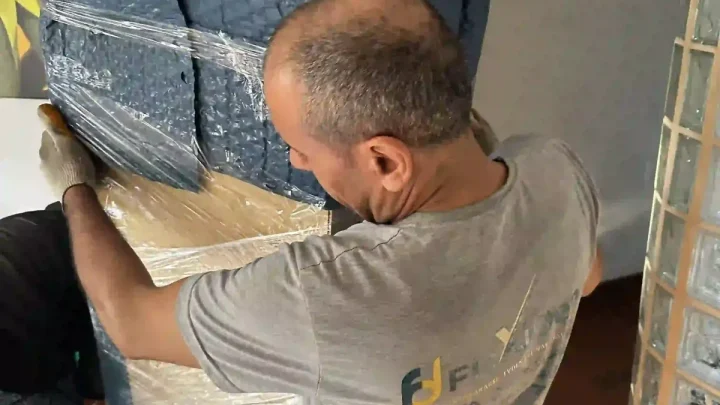
- Dismantling and packing: wardrobes, beds and kitchens are dismantled professionally, screws labelled and parts numbered.
- Parking suspension: we advise whether and where a temporary no-parking zone (Halteverbotszone) should be requested so the truck can park right outside.
- Loading and documentation: every box is entered in the inventory list, which accompanies the shipment through to delivery.
The no-parking zone on moving day
In many German city centres it is hard to find space for a large truck. A temporary no-parking zone prevents long carrying distances and fines. It is requested from the local traffic authority and usually has to be signposted a few days in advance. Deadlines and fees vary from city to city. We tell you during the survey whether a zone is needed and can help with the application.
Typical schedule for the Germany – Turkey route
- 8–6 weeks before: survey, quote, decision on transport option and date.
- 6–4 weeks before: gather documents, prepare deregistration, start the inventory list.
- 4–2 weeks before: receive packing materials, pack rarely used items, apply for a no-parking zone.
- Loading day: dismantling, packing, loading, signing the inventory list.
- Transport and customs: drive to Turkey, clearance by our customs team in Istanbul.
- Delivery: delivery, furniture assembly and check against the numbered list.
Create your personal checklist with every task in one minute using the moving planner.
Where in Germany we collect and deliver
Our teams work throughout Germany – in large cities as well as small towns. We travel most often to regions with large Turkish communities: the Ruhr area with Duisburg, Essen, Dortmund, Gelsenkirchen and Bochum; the Rhineland with Cologne, Düsseldorf and Bonn; the Rhine-Main area around Frankfurt, Offenbach and Wiesbaden; Baden-Württemberg with Stuttgart, Mannheim and Karlsruhe; Bavaria with Munich, Nuremberg and Augsburg; plus Berlin, Hamburg, Bremen and Hanover. Because we drive these routes regularly, dates are easy to plan, and part loads usually wait less before departure.
Living in Germany: what to know when moving in
German rental flats are often let without a kitchen. If you are coming from Turkey and own a fitted kitchen, check before the move whether the dimensions fit the new flat; otherwise selling it in Turkey and buying new in Germany is often cheaper than transporting it. Many flats also come without light fittings – only bare cables hang from the ceiling – so bring lamps or plan to buy them in the first few days.
Many house rules set quiet hours, for example on Sundays and in the evenings. Our teams schedule deliveries on weekdays during the day. Let the building management and neighbours know shortly beforehand – especially if a lift needs to be reserved or a courtyard used for loading.
What does a move between Germany and Turkey cost?
Flat prices mean little on this route, because the difference between a student room in Berlin and a detached house in the Black Forest is enormous. What matters is the net volume, the transport option, the packing service, the floor and access at both addresses, and any extras such as storage or kitchen installation. You can save money by decluttering beforehand, packing boxes yourself and choosing a flexible date for a part load. Costs rise with short-notice bookings, difficult access or many fragile items requiring special packing. Our quote lists every item separately, so you know exactly what you are paying for.
Checklist: deregistering in Germany
When leaving Germany, think about your contracts as well as the move. Deregister at the Bürgeramt – no earlier than a week before moving out – and keep the deregistration certificate safe, as Turkish customs often requires it. Cancel your tenancy, electricity, gas, internet, mobile phone and broadcasting fee in good time. Inform your health insurer, pension fund, employer, bank and insurers. Set up mail forwarding with Deutsche Post. Remember the handover of the flat too: many leases require it to be swept clean or redecorated, so plan a day after loading for this. On request we can dispose of furniture that is not coming with you.
Checklist: a fresh start in Germany
If you are moving from Turkey to Germany, prepare the first weeks carefully. Register at the Bürgeramt within two weeks, then apply for your tax ID, health insurance and a bank account. For a tenancy, landlords often ask for proof of income, a certificate showing no rent arrears and a deposit, usually up to three months’ basic rent. You must register for electricity, internet and the broadcasting fee yourself.
Schedule the delivery of your belongings only once you have the keys to your flat. If that is not possible, we store your shipment until the flat is ready. Many customers first move into a furnished temporary flat and have their household goods follow a few weeks later – something that is easy to organise with a part load. Your contact person agrees with you on the order that makes most sense in your situation.
Why customers choose us for this route
Our customers value having a single contact person who speaks the languages and knows both countries. Our own branch in Germany combined with our own customs team in Istanbul means information is not lost between several companies. And because we calculate in net m³, the final price matches the quote.
Practical tips
- Keep documents separate: passport, deregistration certificate, tenancy agreement and customs papers belong in your hand luggage, not in the truck.
- Check electrical appliances: German and Turkish appliances both run on 230 V and plugs usually fit. Large appliances should be clean and dry before transport.
- Secure the washing machine: the drum transit bolts prevent damage. If you no longer have them, let us know.
- Carry valuables yourself: jewellery, cash and important data storage devices are best taken with you.
- Estimate volume realistically: basements, attics and balconies are often forgotten. The m³ calculator helps you keep track.
Cities we cover
Berlin, Hamburg, Munich, Cologne, Frankfurt, Stuttgart, Düsseldorf, the Ruhr area and every other town. Small volumes via part load.